

By Kevin Donoghue, Solicitor Advocate and Founding Director at Donoghue Solicitors
I have spent the best part of 25 years holding police forces to account for the force they use against the public.
My successful clients include Edwin Afriyie, who won his case at the Court of Appeal after being unlawfully tasered by a City of London Police Officer.
So, when a new use-of-force device starts making headlines abroad, I notice. This one is called the G.L.O.V.E. – an acronym for Generated Low Output Voltage Emitter.
Catchy.
This new device deserves the same scrutiny I have applied to Tasers. Let’s dive in.
What is the G.L.O.V.E.?
As you can see in the video below, the G.L.O.V.E is essentially a pair of gloves that can deliver an electric shock through direct skin contact. It is more formally described as a “wearable conducted electrical weapon device”.
The manufacturer, Compliant Technologies of Kentucky, USA, describes it as a “CD3” device. Another acronym. This one stands for “Conductive Distraction and De-escalation Device” and is, they claim, a “Force Multiplier” which “operates within the Force Continuum as “The New Protocol in Peace Keeping”. (What a word salad that is.)
How Does the G.L.O.V.E. Work?
In this article, the author describes how each G.L.O.V.E. is activated by pressing the on/off button on top of the glove. Then, the two conductive electrode pads in the palm side of the glove deliver an electrical pulse when laid on the subject/ victim. According to the manufacturer’s user manual, the current model (CT-G5) runs at 324 – 362 volts, delivering roughly 30 pulses a second.
The company says the weapon causes “neuro peripheral interference”: involuntary loss of muscle control and significant pain, enabling the G.L.O.V.E. wearer to subdue the subject person.
The manufacturers caution that:
- no more than two (one pair or equivalent) of G.L.O.V.E. devices should be applied at one time to a single subject.
- no more than 15-second activation duration should be deployed
- the device must come into contact with the subject’s skin, but it is not effective through clothing or hair. This means that it can be less effective on “individuals or animals that are extremely hairy”.
- it will function through soaked thin clothing layers (eg. T-shirts, thin blouses, etc) but can’t be immersed in water
- it should not be used around flammable substances.
Helpfully, the device records “thousands of (activation) events”, which may be useful in subsequent civil/ criminal cases.
How Does It Compare to a Taser?
The key “selling point”, if there is one, about Taser weapons is that they are meant to enhance police officer safety. Officers can keep their distance, as the taser barbs travel between 15-45 feet (4.57-13.72 metres) depending on the model.
By contrast, the G.L.O.V.E. is literally hands-on, and must be used in close quarters, where the risk of secondary injury to both victim and officer is greater. For example, Edwin Afriyie suffered secondary injuries when he was effectively paralysed by the Taser. He banged his head on a stone ledge as he fell, causing serious, and entirely avoidable, injuries. I can only imagine the outcry if a desperate victim wrestled the G.L.O.V.E.s off a police officer’s hands and used them to shock the officer instead.
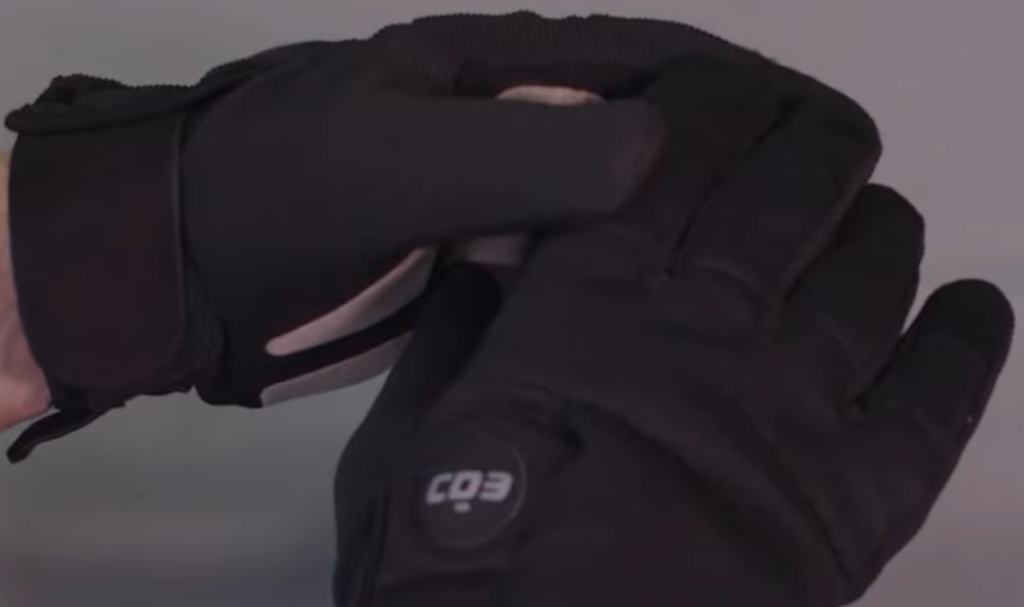
 The G.L.O.V.E. (Generated Low Output Voltage Emitter) is a wearable conducted electric weapon device that looks like a pair of ordinary work gloves.
Also, as you can see in the image above, unlike a bright yellow Taser, the G.L.O.V.E.s look like an innocent pair of heavy work gloves. It is unlikely that a subject/ victim would know that the gloves an officer was wearing could give them a painful, paralysing shock. (I suggest that even changing their colour to Taser yellow would not be enough.) That makes this particular use of force problematic when used as a safety, rather than pure compliance tool, as officers would have to explain how the G.L.O.V.E. works to someone who may not be in a fit state to absorb the information.
But I would make the same point I make about Tasers: a “less lethal” weapon is not a low-risk weapon, it is simply a weapon whose harm is harder to see and prove. The Instagram video below shows it in action. It should be noted that the demonstrator is using only one glove, reducing the effect considerably. He also operates it on grown men, when, as I will show later, the device has also been used on children.
(I suspect Eminem was not asked for his permission to use his music.)
View this post on Instagram
As the chief of the Cape Girardeau Police Department in southeastern Missouri said, “It hurt a lot. I went down to my knees. I couldn’t think of anything other than I wanted the pain to stop.” (It should be noted that, despite that experience, this officer supported their use and his police force owns between 15 and 20 pairs of the gloves.)
Experiencing this level of pain is not a minor irritant. It is pain compliance by another name, and I have represented enough clients injured by “less-lethal” devices to know that the marketing and promotion of these weapons is out of touch with reality.
To be fair, it should be noted that the manufacturers explicitly say:
The G.L.O.V.E. SHALL NOT be deployed for any of the following:
Verbal defiance or belligerence
Punishment
Torture
Horse play
Whether police forces and officers take that advice is another thing completely.
Who Is Already Using This Technology?
More than 50 US police departments across roughly 20 states already use the device.
Prisons, hospitals, and, most worryingly of all, schools are buying and using them. As this report notes, people at an Omaha, Nebraska school board meeting pushed back against their use:
Parents and students talked about fears that the shocks could cause heart problems, or that children with autism or other disabilities could be perceived as causing trouble when they are having emotional issues.
Despite such concerns, Immigration and Customs Enforcement (ICE) in America has ordered $20 million worth, meaning that they will soon become a common tool for federal officers in all 50 states.
What Does UK Law Say About Use of Force Technology Generally?
The G.L.O.V.E. would be considered a use of force device in policing. The Court’s judgment in Mr Afriyie’s case against City of London Police contained several important points about these devices, which include tasers, some of which other victims have used in their cases. These include:
- reminding the police and public that a Taser is a firearm, and classed as a prohibited weapon under section 5(1)(b) of the Firearms Act 1968. It is not merely a “stun gun” as the police like to call it.
- noting that tasers should not be used as a “compliance tool”, and quoting the police’s own guidance which says that:
“Taser should only be used as a proportionate response to an identified threat. It should not be used to simply gain compliance with instructions or procedures where compliance is not linked to such a threat or where a threat has been reduced to such an extent that Taser use would no longer be proportionate. The duration of the initial discharge and any subsequent discharge must be proportionate, lawful, accountable and absolutely necessary (PLAN).”
The Afriyie case also set an important extra task for judges considering use of force cases: even if they find that subjectively the officer had a genuinely held belief that he or she was justified in using such force, the court must also consider objectively if the use of force was reasonable in the circumstances.
This two-stage test must be followed in all cases involving use of force in the Court of Appeal and all other lower courts when considered by judges hearing similar cases.
By now this crucial extra step should have found its way into official guidance and training.
How Would the G.L.O.V.E. Specifically be Viewed by UK Courts?
To their credit, the G.L.O.V.E. manufacturers promote following official guidance in their user manual. It says:
Any use of force, including CD3 deployment, may cause or contribute to death or serious injury. Follow your agency’s guidance and policies when dealing with medically compromised persons.
Various Agencies are called upon daily to deal with the general public. Sometimes the response is to individuals in various states or mind, or emotion and often times under the influence of some form of drug or alcohol. These individuals may also have underlying medical conditions that may or may not be easily discernable with casual observation and thus may be susceptible to an arrest-related death.
When dealing with suicidal individuals, be sure to follow your agency’s polices, TTPs and other related protocols when dealing with these subjects.
(my emphasis)
They also advise that:
Compliant Technologies recommends avoiding use of these devices on the following higher risk portions of the population:
The elderly
Small children
Pregnant women
The severely handicapped
And yet, despite these warnings, “Compliant Technologies does not consider CD3 Technology to be a weapon due to the low electrical current deployed.”
But this is a device that inflicts a 300+ volt shock. I expect that a UK court would disagree and find that it is a weapon under the Firearms Act, not merely a de-escalation tool. Even selling it in the UK might be problematic, as Amnesty International notes:
Electric-shock weapons are prohibited under The Trade in Torture etc. Goods (Amendment) (EU Exit) Regulations 2020, and current Government export control guidance clearly states that all trading activity, including promotion and marketing of these goods anywhere in the world, is prohibited.
Are UK Police Forces Looking at G.L.O.V.E.s?
Despite Amnesty’s warnings, a UK company called The Squad Group describes itself as the UK and Ireland partner for the G.L.O.V.E. and demonstrated it at the Emergency Services Show. According to the show’s website:
The Emergency Services Show attracts a unique audience of over 12,000 key buyers, decision-makers, and frontline experts from the entire blue light sector—including police, fire & rescue, ambulance, search & rescue, and voluntary/support organisations.
The promotion of this product at a trade show targeting police forces should be taken seriously. It is likely that The Squad Group has contacts and credibility in the law enforcement community because it is run by three former police officers including Matthew Nicholls, former Assistant Chief Constable of Hertfordshire Constabulary.
As far as I know, no force has publicly confirmed a trial…yet.
When America Sneezes..?
Tasers arrived in UK policing on the promise that they were a “less lethal” option to deal with dangerous situations.
Two and a half decades and one Court of Appeal judgment later, we know that promise came with a cost: disproportionate use against Black, Asian and minority ethnic people, serious injuries, and, in many tragic cases, death.
I have no interest in scaremongering. But I hope that if the G.L.O.V.E. ends up (literally) in the hands of British police, it arrives with proper vetting, training, and a legal basis for its use that has been tested. Given that the police operate only with the consent of the public, that is the least we deserve.
Kevin Donoghue is the founding director of Donoghue Solicitors, a Solicitor Advocate, and winner of the 2025 Liverpool Law Society Outstanding Lawyer Award for his groundbreaking work in the niche of civil actions against the police. Contact him here.
